 Hello World KitchenBeta
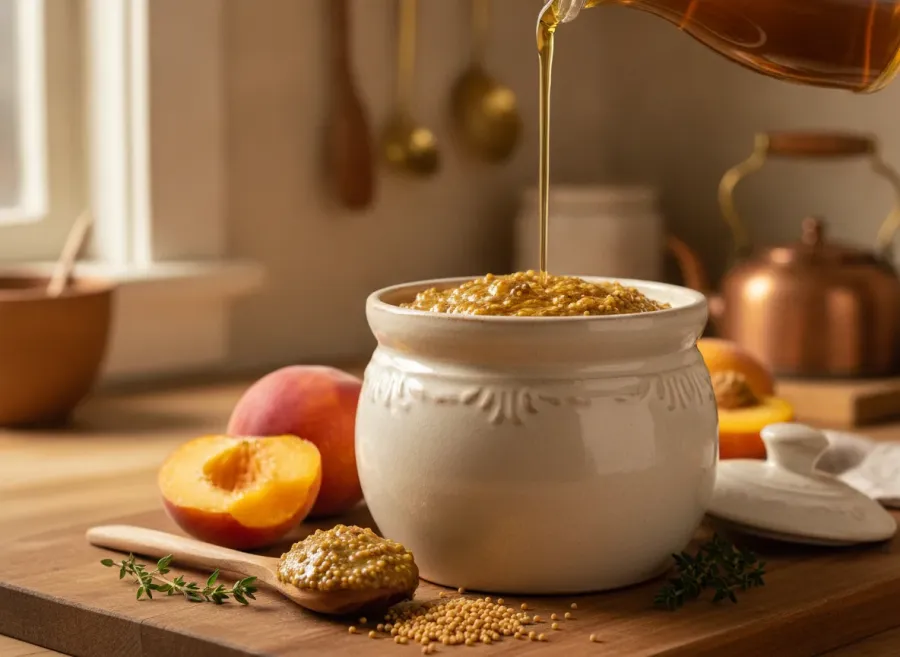
A tangy, sweet, and pungent mustard that blends fresh summer peaches with yellow mustard seeds through a traditional lacto-fermentation process, finished with a splash of raw apple cider vinegar.
Ingredients
Fermentation Base
- 2 cups Fresh peaches — Pitted and finely diced (approx. 2-3 medium peaches)
- 0.5 cups Yellow mustard seeds — Whole
- 2 teaspoons Non-iodized fine sea salt — Iodine can inhibit fermentation. Best to weigh: you want 2% of total weight of peaches and mustard seeds.
- 0.25 cups Filtered water — Must be unchlorinated
Finishing Ingredients
- 0.25 cups Raw apple cider vinegar — With 'the mother'
- 1 tablespoons Raw honey (optional) — To balance the acidity
Instructions
-
Wash the peaches thoroughly, remove the pits, and finely dice them. You can leave the skins on for extra wild yeast, which aids fermentation.
~10 minUsing slightly underripe to perfectly ripe peaches works best, as overripe peaches can turn to mush too quickly. -
In a clean mixing bowl, combine the diced peaches, whole yellow mustard seeds, and non-iodized sea salt. Massage the mixture gently for a few minutes to encourage the peaches to release their juices.
~5 minIf the peaches are dry, you can add the 1/4 cup of filtered, unchlorinated water to ensure there is enough liquid to create a brine. -
Pack the peach and mustard mixture tightly into a sanitized 1-pint mason jar. Press down firmly to eliminate air pockets and allow the liquid to rise above the solids.
~5 minLeave at least 1 inch of headspace at the top of the jar to allow for expansion during fermentation. -
Place a fermentation weight (or a folded piece of parchment/cabbage leaf) on top of the mixture to keep all solids submerged under the liquid brine. Attach an airlock lid, or a standard lid screwed on loosely.
If any solids float to the surface, they may develop mold. Submersion is key to lacto-fermentation safety. -
Place the jar in a cool, dark place (65-72°F) for 5 to 7 days. If using a standard lid, 'burp' the jar once a day by briefly unscrewing the lid to release built-up carbon dioxide.
~168hSafety Indicators: Bubbling is a sign of healthy fermentation. The brine should turn cloudy, and it should smell pleasantly sour and fruity. If you see fuzzy mold (blue, green, or black) or it smells putrid like rotting garbage, discard the batch. A thin white film on top (Kahm yeast) is safe but should be skimmed off. -
After 5 to 7 days, taste a tiny amount. It should be tangy and funky. Once it reaches your desired flavor, pour the contents of the jar into a food processor or blender.
-
Add the raw apple cider vinegar (and honey, if using) to the blender. Blend until you reach your preferred mustard consistency (smooth or slightly coarse).
~5 minThe vinegar halts the fermentation process, stabilizes the mustard, and adds a bright Appalachian zing. -
Transfer the blended mustard to a clean jar and store in the refrigerator. The flavors will meld and the harsh mustard bite will mellow out over the next week.
Mustard seed heat dissipates over time; if it tastes too spicy on day one, wait a few days before eating.
Nutrition
Equipment
- 1-pint glass mason jar
- Fermentation weight or small cabbage leaf
- Airlock lid (optional, but recommended)
- Food processor or blender
- Kitchen scale
Tips & Storage
- Always use non-chlorinated water and non-iodized salt, as chlorine and iodine will kill the beneficial lactobacillus bacteria needed for fermentation.
- Sterilize your jars and equipment before starting to prevent cross-contamination from harmful bacteria.
- The longer the mustard sits in the fridge after blending, the more complex and mellow the flavor becomes. Try to wait at least 3 days before serving.
- Storage: Store in an airtight container in the refrigerator for up to 6 months. Because it is a live fermented product, its flavor will continue to slowly develop over time, and the vinegar acts as a natural preservative.
Tags
🤖 This recipe was created with AI assistance. If you spot a mistake or something that doesn't look right, please report it.


