 Hello World KitchenBeta
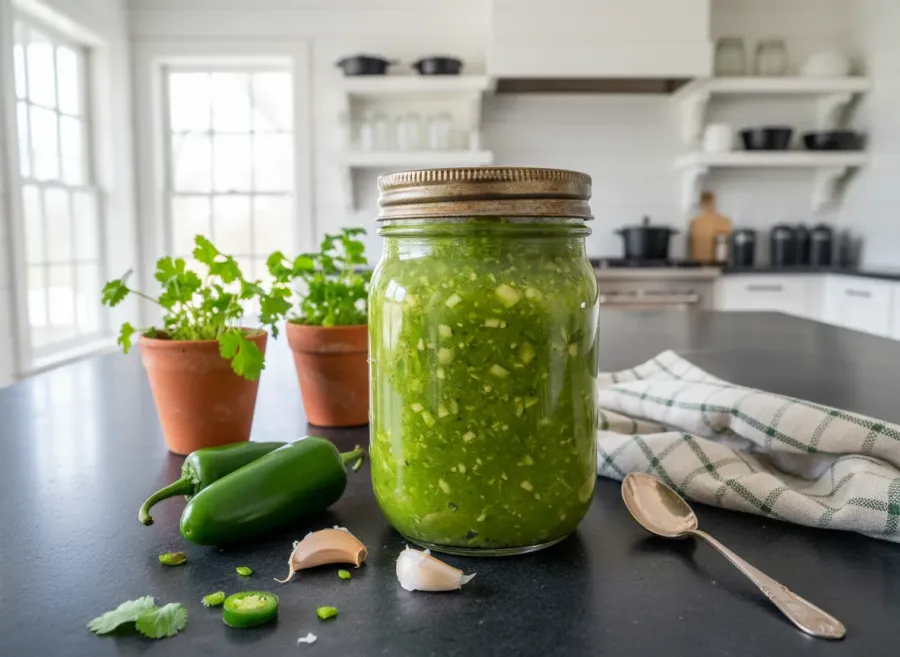
A tangy, complex, and probiotic-rich hot sauce made by lacto-fermenting fresh jalapeños and garlic. Fermentation develops a deep, umami flavor profile that vinegar alone cannot achieve.
Ingredients
Ferment
- 350 grams Fresh jalapeño peppers — washed, stems removed, halved (leave seeds for heat)
- 20 grams Garlic cloves — peeled and smashed
- 500 grams Filtered water — must be chlorine-free
- 26 grams Sea salt or kosher salt — non-iodized; 3% of the total weight of water + peppers + garlic
Blending
- 2 tablespoons White wine vinegar or apple cider vinegar (optional) — to taste, adjusts acidity and stops fermentation
Instructions
-
Place a clean quart mason jar on your kitchen scale and tare it to zero.
~2 minCleanliness is crucial in fermentation to prevent unwanted mold. -
Pack the jalapeño halves and smashed garlic tightly into the jar, leaving at least 1.5 inches of headspace at the top.
~5 minIf you prefer a milder sauce, remove the seeds and white ribs from the jalapeños before packing. -
Pour the filtered water over the peppers until they are completely submerged. Note the total weight of the peppers, garlic, and water.
~2 minFor example, if peppers + garlic = 370g and water = 500g, total weight = 870g. -
Calculate 3% of your total weight (e.g., 870g * 0.03 = 26.1g). Weigh out this amount of non-iodized salt.
~2 minA 3% salt concentration creates an optimal environment for lactobacillus bacteria while inhibiting harmful pathogens. -
Pour the water out of the jar into a separate bowl, leaving the peppers in the jar. Whisk the calculated salt into the water until completely dissolved to create your brine, then pour the brine back over the peppers.
~4 minUsing warm water helps salt dissolve faster, but let it cool to room temperature before pouring over the peppers to avoid killing the bacteria. -
Place a glass fermentation weight on top of the peppers to keep them completely submerged under the brine. Attach a fermentation airlock lid.
~2 minIf any peppers float above the brine, they can grow mold. If you don't have an airlock, use a standard lid but loosen it slightly once a day to 'burp' the gas. -
Place the jar in a cool, dark place (away from direct sunlight) at room temperature (65°F-75°F) to ferment for 14 to 21 days.
~336hThe brine will become cloudy and you will see bubbles forming. This is normal and a sign of active lacto-fermentation. -
After 2 to 3 weeks, taste a piece of pepper. It should be pleasantly sour and tangy. Strain the contents over a bowl, reserving the fermentation brine.
~3 minDo not discard the brine! It is needed to adjust the consistency of the sauce. -
Transfer the fermented jalapeños and garlic to a blender. Add 1/2 cup of the reserved brine (and the optional vinegar, if using). Blend on high until completely smooth.
~3 minAdd more brine as needed to reach your desired hot sauce consistency. -
For a smoother, commercial-style sauce, press the blended mixture through a fine mesh strainer to remove skins and seeds. Pour the finished sauce into clean bottles using a funnel.
~5 minThe leftover pulp can be dehydrated to make a spicy, fermented chili powder!
Nutrition
Equipment
- Digital kitchen scale (grams)
- Quart-sized glass mason jar (wide mouth preferred)
- Fermentation weight (glass or ceramic)
- Fermentation lid with airlock (or standard lid for daily burping)
- Blender or food processor
- Fine mesh strainer (optional)
- Funnel
- Glass bottles for storing
Tips & Storage
- Always use non-iodized salt (like sea salt or kosher salt) as iodine can inhibit fermentation.
- Chlorine in tap water can kill the good bacteria needed for fermentation. Always use filtered or distilled water.
- A white film (kahm yeast) may develop on the surface during fermentation. It is harmless but can affect the flavor; skim it off if it appears. Fuzzy or colored mold means the batch should be discarded.
- Storage: Store the bottled hot sauce in the refrigerator. The cold temperature will dramatically slow down the fermentation process, preventing pressure build-up. It will keep for 6 months to a year.
Tags
🤖 This recipe was created with AI assistance. If you spot a mistake or something that doesn't look right, please report it.


