 Hello World KitchenBeta
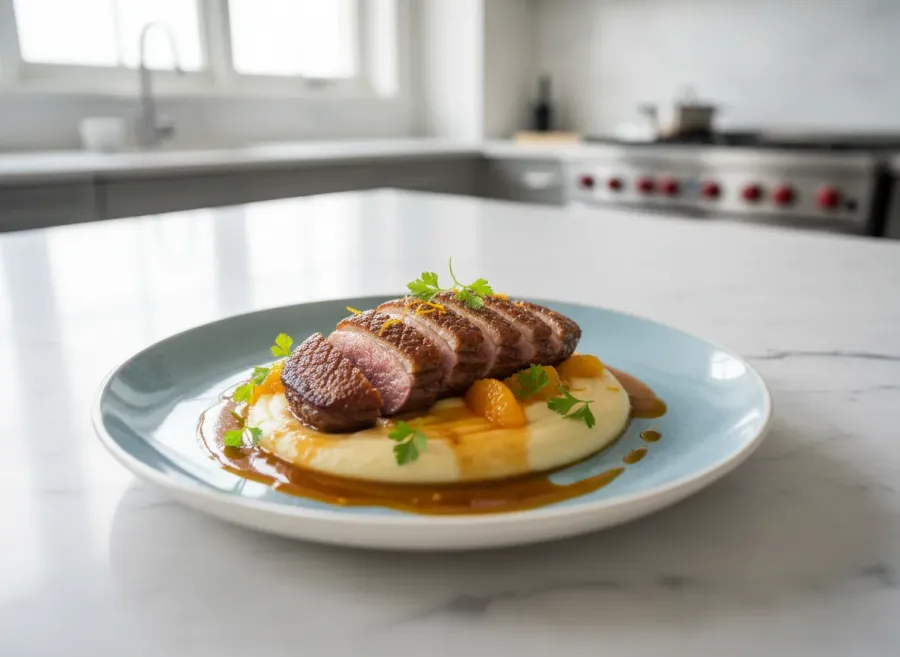
A classic, elegant French entrée featuring perfectly pan-seared duck breast with crispy skin, served alongside a silky parsnip purée and a balanced sweet-and-sour orange sauce.
Ingredients
Duck
- 2 pieces Duck breasts (Magret or Moulard) — About 6-8 oz each, patted dry
- 1 teaspoon Kosher salt — For seasoning
- 0.5 teaspoon Black pepper — Freshly ground
Parsnip Purée
- 1 pound Parsnips — Peeled, woody core removed if large, roughly chopped
- 1 cup Heavy cream
- 1 cup Whole milk — Plus more if needed to cover
- 2 tablespoons Unsalted butter — Cut into cubes
- 0.25 teaspoon White pepper (optional) — To taste
Orange Sauce (Gastrique)
- 2 tablespoons Granulated sugar
- 2 tablespoons White wine vinegar
- 0.5 cup Fresh orange juice — From about 2 oranges
- 1 tablespoon Orange zest — Finely grated
- 0.5 cup Duck or chicken stock — Low sodium
- 1 tablespoon Unsalted butter — Cold
- 1 teaspoon Grand Marnier or Cointreau (optional) — For finishing
Instructions
-
Prepare the duck breasts: Using a very sharp knife, lightly score the duck skin in a crosshatch pattern, spacing the cuts about 1/2-inch apart. Be careful to cut only through the fat, not into the flesh. Pat completely dry and season generously with salt and pepper on both sides. Leave at room temperature for 15 minutes.
~15 minScoring the fat allows it to render properly, resulting in a crispy skin. -
Cook the parsnips: Place the chopped parsnips in a medium saucepan. Pour in the heavy cream and milk (add a splash of water if the parsnips aren't mostly submerged). Bring to a gentle simmer over medium heat, then reduce heat to low, cover, and cook until the parsnips are very tender.
~20 minWatch carefully as milk and cream can easily boil over. -
Start the duck: Place the seasoned duck breasts skin-side down in a cold cast-iron skillet. Turn the heat to medium-low. As the pan heats, the fat will slowly render. Cook until the skin is deep golden brown and crispy, about 12-15 minutes. Spoon out excess fat as it renders (save it for roasting potatoes!).
~15 minStarting in a cold pan is the secret to perfectly rendered, crispy duck skin. -
Finish the duck: Flip the duck breasts and cook on the flesh side for 2-4 minutes for medium-rare (internal temperature of 130°F). Transfer to a cutting board, tent loosely with foil, and let rest for 10 minutes.
~4 minResting is crucial to allow the juices to redistribute. -
Purée the parsnips: While the duck rests, use a slotted spoon to transfer the cooked parsnips to a blender. Add 2 tablespoons of the cooking liquid and the butter. Blend until completely smooth, adding more cooking liquid a tablespoon at a time if necessary. Season with salt and white pepper. Keep warm.
~5 minFor an ultra-silky texture, pass the purée through a fine-mesh sieve after blending. -
Make the orange sauce: In a small saucepan, melt the sugar over medium heat until it turns a light amber caramel (do not stir, just swirl the pan). Carefully whisk in the white wine vinegar (it will bubble vigorously) and cook for 1 minute to dissolve the sugar. Add the orange juice, zest, and stock. Increase heat to medium-high and boil until reduced by half and slightly syrupy.
~10 minThis sugar-vinegar base is called a gastrique, which balances the richness of the duck. -
Finish the sauce: Remove the sauce from heat. Whisk in the cold butter to give the sauce a glossy finish. Stir in the Grand Marnier, if using. Season with a pinch of salt if needed.
~2 minDo not boil the sauce after adding the butter, or it may break. -
Plate and serve: Slice the duck breasts against the grain into 1/2-inch thick slices. Spoon a generous amount of parsnip purée onto each plate. Arrange the duck slices over or next to the purée, and drizzle the orange sauce over the duck.
~3 min
Nutrition
Equipment
- Cast iron skillet
- Small saucepan
- Medium saucepan
- Blender or food processor
- Fine mesh strainer
- Sharp knife
- Cutting board
Tips & Storage
- Save the rendered duck fat in a glass jar in the fridge; it is liquid gold for roasting vegetables or frying potatoes.
- Make sure your orange juice is freshly squeezed. Bottled juice lacks the bright acidity needed for this dish.
- If the parsnip purée cools down too much, gently reheat it in a saucepan over low heat, stirring constantly to prevent sticking.
- Storage: Store leftover duck and purée in separate airtight containers in the refrigerator for up to 3 days. Reheat the duck gently in a low oven to prevent overcooking, and reheat the purée on the stovetop with a splash of milk.
Tags
🤖 This recipe was created with AI assistance. If you spot a mistake or something that doesn't look right, please report it.


