 Hello World KitchenBeta
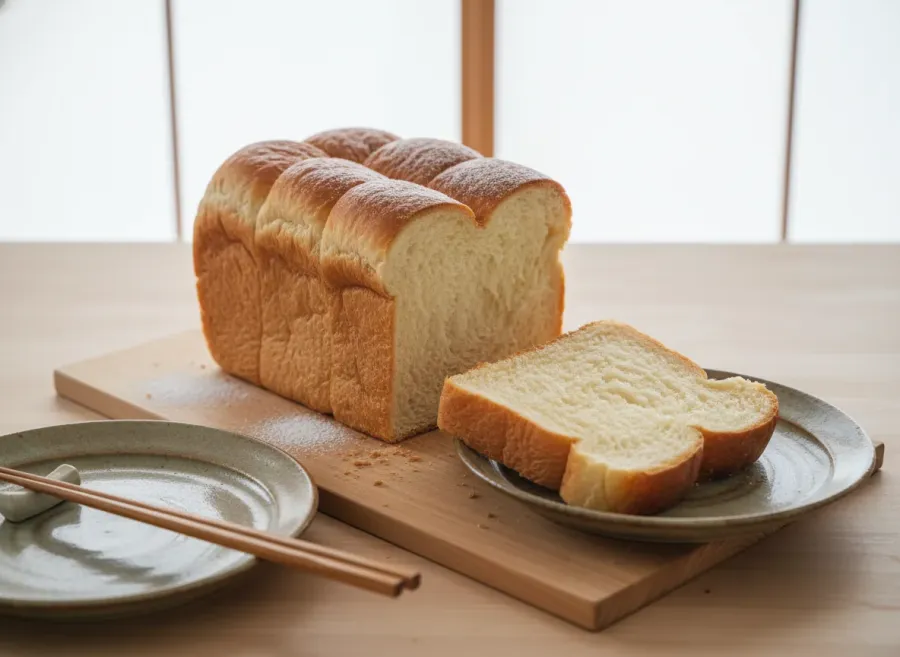
A classic Japanese Shokupan recipe using the tangzhong method to create a loaf with an incredibly soft, feathery, and tearable crumb. Enriched with milk, heavy cream, and butter, it boasts a rich milky flavor perfect for thick toast or delicate sandwiches.
Ingredients
Tangzhong (Water Roux)
- 20 grams Bread flour — High protein (12-13%) preferred
- 45 grams Water
- 45 grams Whole milk
Main Dough
- 320 grams Bread flour — High protein
- 40 grams Granulated sugar
- 15 grams Dry milk powder — Enhances the milky flavor
- 6 grams Fine sea salt
- 6 grams Instant yeast
- 130 grams Whole milk — Lukewarm
- 40 grams Heavy cream — Room temperature
- 30 grams Unsalted butter — Softened to room temperature
Instructions
-
Make the tangzhong: In a small saucepan, whisk together 20g bread flour, 45g water, and 45g whole milk until smooth. Cook over medium-low heat, whisking constantly, until the mixture thickens into a thick paste (about 65°C/149°F). The whisk should leave clear lines in the bottom of the pan. Remove from heat, transfer to a small bowl, cover with plastic wrap touching the surface, and let cool to room temperature.
~5 minMaking the tangzhong the night before and chilling it allows for even better hydration, just let it come to room temp before using. -
In the bowl of a stand mixer fitted with the dough hook, combine the bread flour, sugar, milk powder, salt, and instant yeast. Stir briefly to combine.
~2 minKeep the yeast and salt on opposite sides of the bowl before mixing so the salt doesn't kill the yeast. -
Add the lukewarm milk, heavy cream, and the cooled tangzhong to the dry ingredients. Mix on low speed until a shaggy dough forms and no dry flour remains.
~3 min -
Increase the mixer speed to medium-low and knead for about 8-10 minutes until the dough becomes somewhat smooth and elastic. Add the softened butter, one piece at a time, continuing to mix. The dough will look greasy and fall apart initially; continue kneading for another 10-15 minutes until it comes back together and is very smooth, elastic, and clears the sides of the bowl.
~25 minPerform the windowpane test: gently stretch a small piece of dough. If it stretches thin enough to let light through without tearing, it is ready. -
Shape the dough into a smooth ball. Place it in a lightly greased bowl, cover loosely with plastic wrap or a damp towel, and let it rise in a warm spot until doubled in size.
~60 minIdeal proofing temperature is around 80°F (27°C). -
Punch down the dough to deflate it. Transfer to a lightly floured surface and divide it evenly into 3 or 4 equal portions (depending on your pan's preference, typically 3 for a standard pullman). Shape each portion into a smooth ball. Cover and let rest for 15 minutes to relax the gluten.
~15 minUse a digital scale to ensure the dough balls are exactly the same weight for an even loaf. -
Shape the dough: Roll one dough ball out into a long oval. Fold the top third down to the center, and the bottom third up to the center (like a letter). Rotate 90 degrees, then roll it out again into a long rectangle. Roll the rectangle up tightly from the short end into a cylinder. Pinch the seam closed. Repeat with the remaining dough balls.
~10 minRolling the dough tightly and uniformly is key to the feathery, shreddable texture of shokupan. -
Place the shaped dough cylinders seam-side down into a greased 9x4-inch Pullman loaf pan. Cover the pan and let the dough rise until it reaches about 80% of the way to the top of the pan.
~60 min -
Preheat your oven to 375°F (190°C). Once the dough has proofed, slide the greased lid onto the Pullman pan. Bake for 30-35 minutes.
~35 min -
Remove from the oven and carefully slide off the lid. Immediately turn the loaf out onto a wire cooling rack. Allow the bread to cool completely before slicing.
~15 minSlicing while warm will crush the delicate crumb. Wait at least 2 hours.
Nutrition
Equipment
- Small saucepan
- Whisk
- Stand mixer with dough hook
- 9x4-inch Pullman loaf pan with lid
- Rolling pin
- Kitchen scale
- Dough scraper
Tips & Storage
- Using a high-protein bread flour (around 12.5% - 13% protein) is essential to achieve the strong gluten network required to support the soft crumb.
- The heavy cream and milk powder are what give authentic Japanese Shokupan its distinctively milky, sweet aroma.
- Do not skip the windowpane test; under-kneaded dough will result in a dense loaf.
- For an open-top loaf (mountain bread style), simply leave the lid off the Pullman pan and egg wash the top before baking.
- Storage: Store cooled bread in an airtight container or plastic bag at room temperature for up to 5 days. The tangzhong helps it stay soft. For longer storage, slice the loaf and freeze in a zip-top bag for up to 3 months; toast directly from frozen.
Tags
🤖 This recipe was created with AI assistance. If you spot a mistake or something that doesn't look right, please report it.