 Hello World KitchenBeta
A classic Filipino sour soup featuring tender pork ribs simmered in a rich, tangy tamarind broth with an assortment of fresh vegetables. Comforting, savory, and perfectly sour.
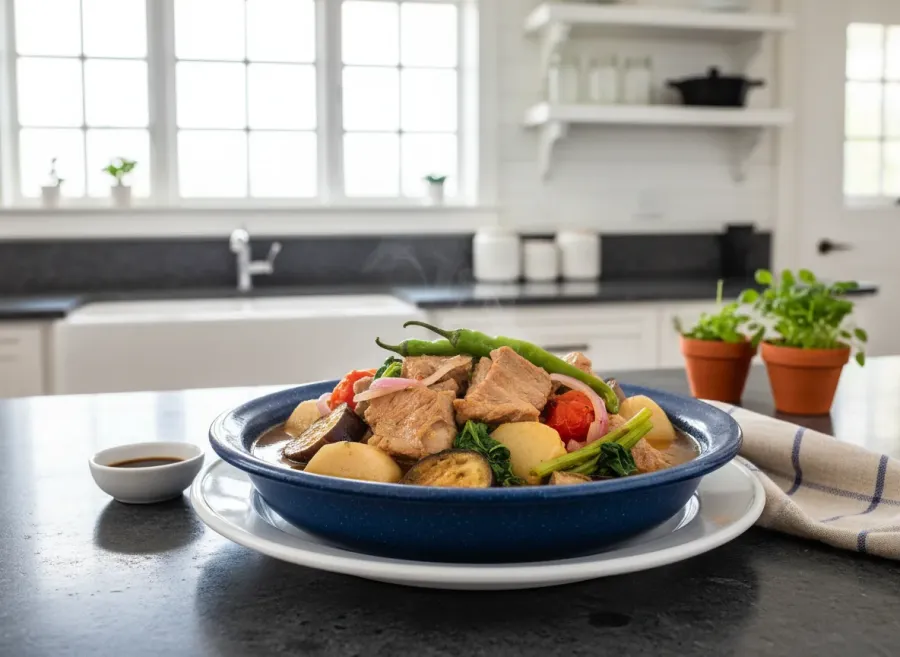
Ingredients
Pork and Broth Base
- 2 lbs Pork ribs or pork belly — Cut into 2-inch chunks
- 8 cups Water — For the soup
- 0.5 lbs Fresh unripe tamarind (sampaloc) — Can substitute with 1 packet (about 40g) of tamarind soup base powder if fresh is unavailable
- 2 medium Roma tomatoes — Quartered
- 1 medium Red onion — Quartered
- 3 tablespoons Fish sauce (patis) — Plus more to taste
Vegetables
- 3 medium Taro (gabi) — Peeled and halved; helps thicken the broth naturally
- 1 medium Daikon radish (labanos) — Peeled and sliced diagonally into 1/4-inch thick pieces
- 1 large Eggplant (talong) — Sliced diagonally into 1/2-inch thick pieces
- 1 bunch Snake beans (sitaw) or green beans — Cut into 2-inch lengths
- 2 whole Long green chili peppers (siling haba) — Kept whole to provide aroma without overwhelming heat
- 1 large bunch Water spinach (kangkong) — Leaves separated, tender stems cut into 2-inch pieces
Instructions
-
In a large soup pot, combine the pork ribs, tomatoes, red onion, and 8 cups of water. Bring to a boil over medium-high heat. Once boiling, reduce the heat to a simmer and carefully skim off any grayish scum that floats to the surface to ensure a clear broth.
~15 minTaking the time to skim the scum thoroughly makes for a cleaner, better-tasting broth. -
While the pork is simmering, prepare the fresh tamarind. In a separate medium saucepan, boil the fresh tamarind in 2 cups of water until the shells burst and the pulp becomes very tender (about 15-20 minutes). Mash the tamarind with a fork in the water, then pour the mixture through a fine mesh strainer into the main soup pot. Discard the seeds and skins.
~20 minIf using a tamarind powder packet instead, skip this step and simply stir the powder into the pork broth later in the recipe. -
Add the taro (gabi) pieces to the soup. Cover and continue to simmer until both the pork and the taro are very tender. The taro will begin to break down slightly, naturally thickening the broth.
~45 minIf you prefer a thinner broth, you can remove the taro once it's cooked rather than letting it dissolve. -
Stir in the fish sauce (patis). Taste the broth and adjust the seasoning—it should be distinctly sour and savory.
~2 minFish sauce adds umami that salt alone cannot provide. -
Add the daikon radish and the whole green chilies. Simmer for 5 minutes.
~5 minDo not slice the green chilies unless you want a very spicy soup. -
Add the eggplant and snake beans. Cook until the vegetables are tender but still vibrant, about 5 to 7 minutes.
~7 minAvoid overcooking the eggplant so it doesn't turn entirely to mush. -
Turn off the heat. Immediately add the water spinach (kangkong) leaves and tender stems, pushing them down into the hot broth. Cover the pot and let the residual heat gently cook the greens for 1-2 minutes.
~2 minKangkong cooks incredibly fast; residual heat prevents it from turning stringy and gray.
Nutrition
Equipment
- Large soup pot or Dutch oven
- Medium saucepan
- Fine mesh strainer
- Ladle
- Cutting board
- Chef's knife
Tips & Storage
- Always serve Sinigang piping hot with steamed white rice. The rice balances the intense sourness of the soup.
- For an extra layer of flavor, serve with a small dipping saucer of fish sauce and a crushed bird's eye chili (siling labuyo) on the side.
- If fresh tamarind is unavailable, tamarind paste or Filipino Sinigang mix packets work excellently and save time.
- Storage: Store leftover soup in an airtight container in the refrigerator for up to 3 days. Reheat gently on the stovetop over medium-low heat. Note that the kangkong will darken upon storing and reheating, which is normal.
Tags
🤖 This recipe was created with AI assistance. If you spot a mistake or something that doesn't look right, please report it.